Please deal well with the usage of the word nigger
and accept it in the era of time and the context in which it is used.
Selected Quotes
I WAS A SLAVE
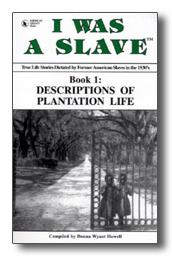
Book 1:
Descriptions of Plantation Life

BETTY POWERS: Twas lak [It was like] a town wid de diffent businesses. Thar am de blacksmith shop, shoe shop, carpenter shop, de milk house, de marster had bout 100 milk cows, de weavin room, de gin, an de feed mill. ... De cullud foks lives in de cabins. Twas called de quatahs [quarters]. Now, in each cabin lives one famly. Twas de father, mother an de chilluns. Thar am bout as many chilluns as thar am grown-ups. Ise can shut my eyes now, an see dem rows of cabins. Thar am three rows, an de rows am bout haf a mile long. Ever famly does its own cookin. Mammy, Pappy, an their 12 chilluns lives in our cabin, so Mammy have to cook fo 14 people, sides her field work. ... De marster am a sweet, fine man. Twas his wife an de overseer dat am tough. Dat womens had no mercy. She am a devil. Gosh fo Mighty!, how Ise hates her. Yous see dem long ears Ise have? Well, dats fom de pullin dey gits fom her. Ise am wokin round de house, keepin flies off de foks, gittin wautah [water] and sich [such]. Fo everthin she dont lak [like], twas a ear-pullin Ise gits. Twas pull, pull, an some mo pull ever time she comes neah me.
I WAS A SLAVE
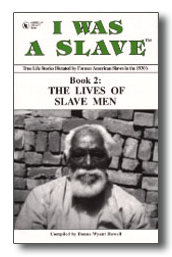
Book 2:
The Lives of Slave Men
.
WES BRADY: We niggers lived in log houses and slep on hay mattress with lowell covers, and et [ate] fat pork and cornbread and lasses [molasses] and all kinds garden stuff. If we et flour bread, our women folks had to slip the flour siftins from Missys kitchen and darsnt [dare not] let the white folks know it. We wore one riggin lowell clothes a year. I never had shoes on til after surrender come. ... The overseer was straddle his big horse at three oclock in the mornin, roustin the hands off to the field. He got them all lined up and then [he] come back to the house for breakfas. The rows was a mile long and no matter how much grass was in them, if you leaves one sprig on your row, they beats you nearly to death. Lots of times they weighed the cotton by candlelight. All the hands took dinner to the field in buckets and the overseer give them fifteen minutes to git dinner. Hed start cuffin some of them over the head when it was time to stop eatin and go back to work.
I WAS A SLAVE
Book 3:
The Lives of Slave Women
.
CHENEY CROSS: I was brung up right in de house wid my white folks. Yessum, I slep on de little trundler bed what pushed up under de big bed, in durinst de day. I watched over dem chillun day an night. I washed em an fed em an played wid em. Granmammy an Mammy wove de cloth for de hands [field hands = field slaves] clothes. ... I was allus [always] dressed in white clothes all frill up wid starch an ribbon an sich [such]. Us had our shoes store bought... Field hands gone barefoot, ceptin in de winter, an den dey had to prepare dey own shoes. Dat was de way it went. You had to prepare for youself an if you aint hab de head to do dat, den you went widout. Dey had a hard time. I dont see how dey manage, but I allus say de Lawd [Lord] was wid em.
I WAS A SLAVE
Book 4:
The Breeding of Slaves

MARY INGRAM: Twarnt any maiiage lowed on de plantation twix some. De marster, he tell who can git maiied an who cant. Him select de potly [portly = large] and plific womens, an de potly man, an use sich fo de breeder an de father of de womens chilluns. De womens dat am selected am not lowed to maiy [marry]. De chilluns dat am bon dat way dont know any father. De womens have nothin to says bout de rangement. If she am potly an well-formed, deys foced her wid de breeder. ... Wy don weuns refuse? Shucks, man, yous don know wat yous says. De rawhide whup [whip] keeps you fom refusin. Ise know cause Ise see de young girls cryin, an dey gits whupped cause deys stubbon. De ol nigger women vise de girls dat twarnt no use to refuse. Dat it jus makes it wose fo dem.
I WAS A SLAVE
Book 5:
The Lives of Slave Children

HENRY KIRK MILLER: The children that werent big enough to work were fed at the white peoples house. We got milk and mush for breakfast. When they boiled cabbage, we got bread and potliquor [the liquid remaining after cabbage was cooked]. For supper, we got milk and [corn]bread. ... As fast as us children got big enough to hire out, she [the mistress] leased us to anybody who would pay for our hire. I was put out with another widow woman who lived about 20 miles. She worked me on her cotton plantation. Old Mistress sold one of my sisters and took cotton for pay. I remember hearing them tell about the big price she brought because cotton was so high [expensive].
I WAS A SLAVE
Book 6:
Slave Auctions

JENNY PROCTOR: When he goes to sell a slave, he feed dat one good for a few days. Den when he goes to put em up on de auction block, he takes a meat skin and greases all round dat niggers mouth to make em look like dey been eatin plenty meat and sich like, and wuz good and strong and able to work. Sometimes he sell de babes from de breas, and den again he sell de mothers from de babes, and de husbands and de wives, and so on. He wouldnt let em holler [scream or cry loudly] much when de folks be sold away. He say, I have you whooped if you dont hush. Dey [The slaveowners] sho loved deir six chillun, though [loved their own six white children, though]. Dey wouldn want nobody buyin dem.
Here's a treat
for Africana studies students and others
who want to learn more about these
true American slave narratives:
The full life story
of
BETTY POWERS
Would you like to go to List of 24 Books?
ORDERING INFORMATION
|
|
|